
Climate risk data is everywhere, answers for businesses are not
Credit: The Globe and Mail
Businesses grappling with several concurrent disruptions need a straightforward and streamlined way to address climate-related risks and build resilience. Yet, the data and analysis that would inform their options and pathways forward remain difficult to access, make sense of, plan around and act on.
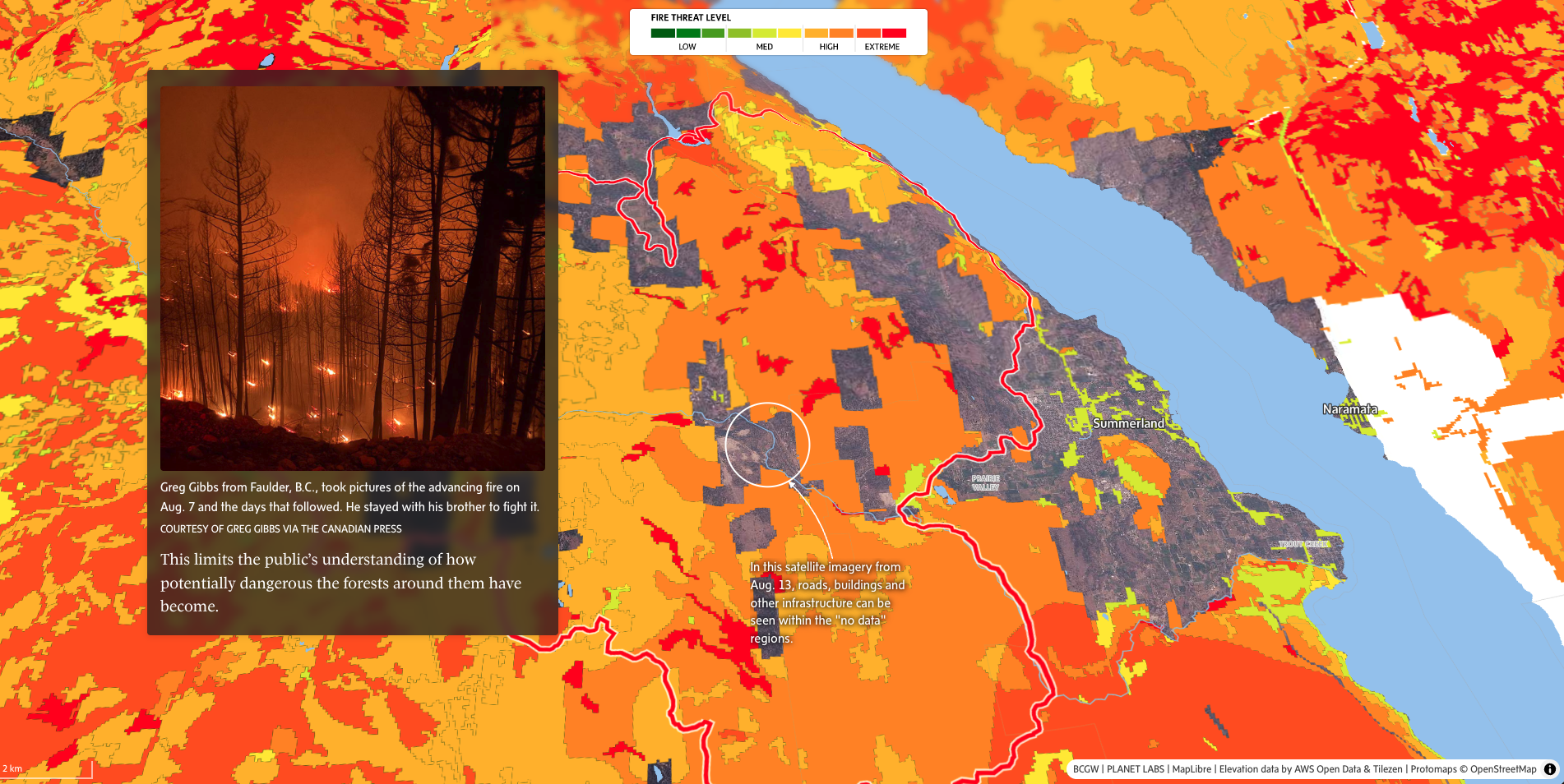
The Globe and Mail put it plainly on 24 September 2026: Canadians are in the dark about their wildfire and flood risks.
For businesses however, there is more to the story. Although several kinds of climate risk intelligence exist, each shows only part of the picture, and none answers the questions a business owner has to contend with: how long a wildfire, flood or other event could shut down a site, whether the business interruption indemnity period is long enough, which supplier or road is exposed, or which resilience investment is worth making first given the business's operating context, including the resilience of the surrounding neighbourhood.
Public data was not built for business decisions
Publicly accessible and free online tools can help businesses better understand, at a high-level, particular climate hazards and their impacts across a region. The British Columbia Hazard Insights Tool, for example, estimates the percentage of businesses exposed to select hazards and their total annual revenue at risk in aggregate; however, it was not designed for community- or property-level decisions. Other public efforts have stalled or are unlikely to be in place before the next season begins: Canada's Flood Risk Finder is available only in the provinces and territories that opt in (none has so far), while a federal decision on the national wildfire hazard mapping program recommended in the Senate's Canada on Fire report is not due until December.
Financial institutions see a clearer picture
Banks and insurers privately hold location-specific data that gives them a significantly clearer view of business risks at both the portfolio and asset levels. The Office of the Superintendent of Financial Institutions (OSFI) describes physical risk data from banks as the most geographically granular dataset not captured in its other regulatory returns, and the Insurance Bureau of Canada's Liam McGuinty told the Globe and Mail that insurers "know a lot" as their risk modelling and mapping have improved markedly in recent years.
Vendor tools help, within limits
Commercial platforms go further than public tools, with some offering resilience measure costing and resilience planning. Canada's ClimateFirst generates "resiliency plans", the United Kingdom's Climate X promotes a return on investment for every adaptation measure, and XDI compares standardized resilience pathways across a portfolio. These tools tend to rely on standard building archetypes, accept only limited inputs and modifications from the customer, and produce generic resilience recommendations regardless of actual property conditions. A small number of vendors, most recently Fathom in the UK, also provide access through their partners' platforms with a view to raising the floor for non-paying users.
Each type of intelligence has its place
Nonetheless, each type of intelligence has its place in building a picture of physical climate risk; the public, financial institution and vendor views each add something the others lack.
That picture is only the first step in an ongoing, iterative process. The process is necessarily informed by a business's actual experience, and it works best when it is integrated into the business's plans and strategies, including the planning of resilience investments.
Where Think Resilience fits
I diagnose climate risk for Canadian small and mid-sized businesses using a global reinsurer's data and analytics, which is closer to what their insurers and lenders see than any public tool. Information alone does not build resilience, however. Its real value is in making governance, implementation and financing conversations possible with insurers, lenders, buyers and suppliers. These are the conversations in which a business's experience and ground-truthing turn the picture into decisions and actions that reduce risks and build resilience now and over the longer term.